5 min
A clear market trend is emerging: hotels are increasingly automating parts of the systems they rely on. But why is this necessary? What are the main benefits, and why have more hotels not yet moved toward autonomous systems? In this article, we explore several aspects of this shift. Our starting point is Hotel Tech Report’s annual PMS report [2], a survey of 450 vetted hotel professionals worldwide, each with at least eight years of experience managing properties of 50+ rooms, investigating attitudes toward automated hotel systems (“the survey”). The appetite for automation is already evident across the industry: 78% of hotel chains use AI today, and 89% are planning additional applications; yet only 1% report that AI is central to their business model [3]. Adoption is broad, but shallow, and that gap is exactly where the next generation of hotel systems will compete.

Push for a connected ecosystem
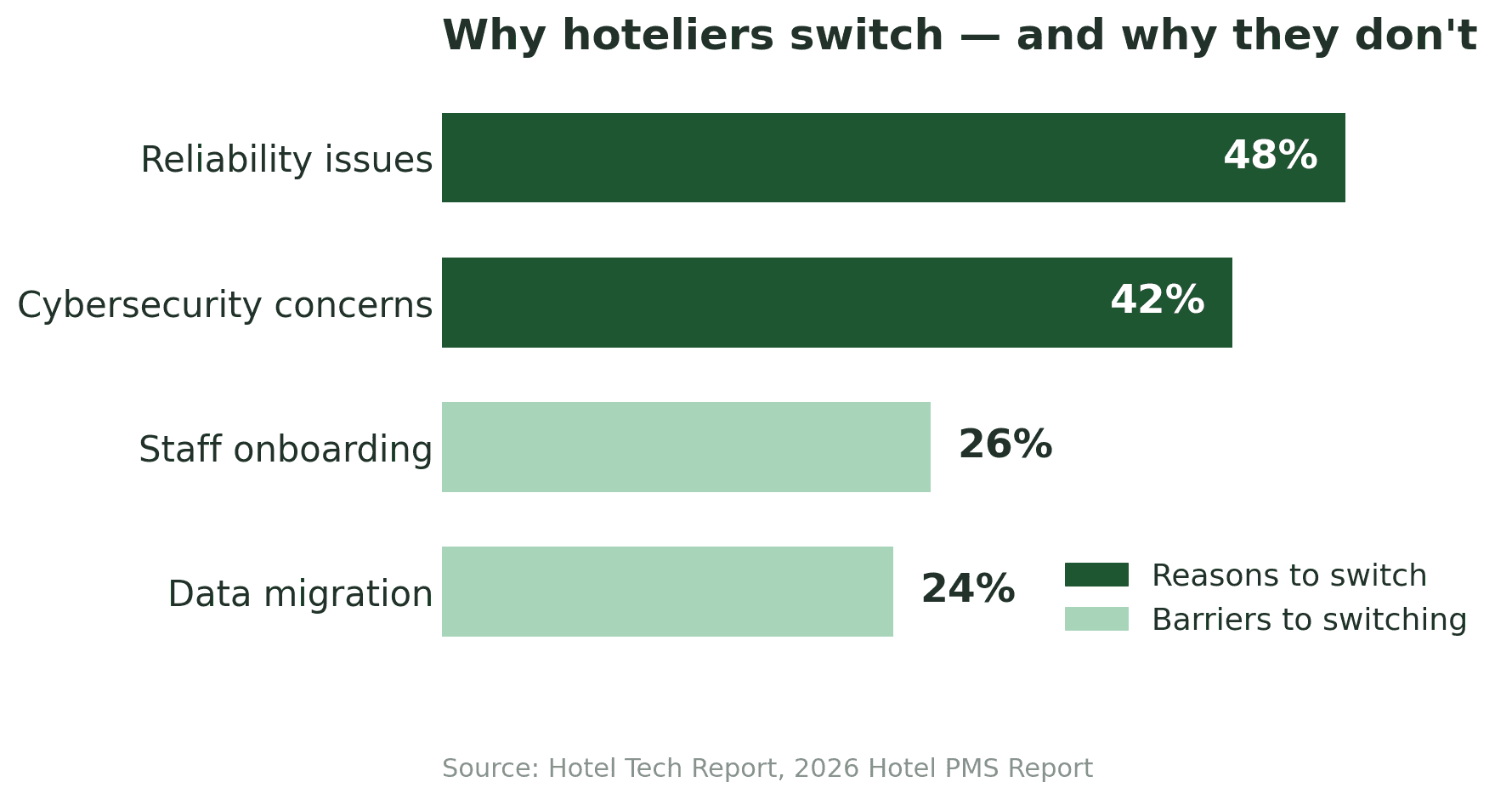
Hotels are heavily dependent on multiple systems to manage the hotel. Unfortunately, hotels usually use between ten and 50 different services at once [1], which drastically complicates the process. The winners of PMS systems will be those that can integrate all features into one service, while being careful with the data: 42% of hoteliers say that cybersecurity concerns alone are enough to make them walk away from a vendor [2]. The demand for consolidation is concrete: 44% of hoteliers highlight housekeeping and operations tools as the most valuable features to integrate into their PMS, while built-in payment processing and housekeeping tools top the overall wish list of features at 60% each [2]. Looking ahead, 49% of operators would like to see AI-powered automation and personalization prioritized next, and 45% call for faster integrations and open marketplaces [2]. The same priorities decide where AI money goes: easy integration (70%), reduction of repetitive tasks (69%) and proven revenue impact (69%) are the main drivers of AI investment decisions among hotel chains [3].
This is the broad-but-shallow gap from the introduction in practice: hotels are experimenting with AI everywhere, but few have the strategy or expertise to make it foundational. The recent surge in agentic AI systems provides a unique opportunity to close that gap, and this is where Zaplar enters.
Switching systems
Despite this, switching systems is painful for venues; there appears to be a push-pull relationship between wanting increasingly many features in the same app and not wanting to deal with the extensive onboarding. In the survey, 26% consider staff onboarding to be the biggest barrier to changing systems, with the complexity of data migration close behind at 24% [2]. The same pattern is visible on the AI side: 62% of hotel chains cite a lack of AI expertise or skill gaps as a barrier to adoption, and 51% do not have a clear AI strategy or roadmap [3]. However, the pain is avoidable — 92% of hoteliers say modern PMS interfaces dramatically reduce staff training time, shrinking onboarding from weeks to days [2]. Hence, vendors focusing on seamless onboarding will, with the help of AI, have a great advantage in attracting new customers.
Reliability
As painful as switching may be, there are still strong reasons for hoteliers to do it. According to the survey, 48% would consider switching vendors over reliability issues [2], making it by far the most common trigger. If a system repeatedly crashes at crucial moments, the number of features it offers becomes irrelevant. Hence, a reliable and robust system will have a major advantage in this regard.
Zaplar
The survey paints a consistent picture of what the winning hotel system looks like. It consolidates a fragmented stack of 10–50 services into one connected ecosystem, because that is what hoteliers ask for first. It makes switching painless, because onboarding and data migration — not lack of interest — are what keep hotels locked into systems they have outgrown. It is reliable and careful with data, because these are the issues hoteliers are willing to leave a vendor over. And it makes deep AI adoption effortless, because 78% of hotel chains are already convinced AI belongs in their operations, while 62% admit that they lack the expertise to take it beyond isolated experiments [3].
Zaplar is built precisely with this in mind. As an operating system built from the ground up with AI, and designed based on hundreds of interviews with hotel owners, it targets the features hoteliers explicitly rank highest, is designed for onboarding measured in days rather than weeks, and treats reliability and data security as foundations rather than afterthoughts. The prize for hotels that get this right is well documented: 89% of hoteliers say their PMS saves their team 2–10 hours every week, and 91% say it directly drives revenue growth through upsells, direct bookings, and rate optimization [2]. The gap between broad and deep AI adoption is where the next generation of hotel systems will be decided, and it is the gap Zaplar is built to close.
References
Skift Research, Hotel Tech Benchmark: Methodology. https://research.skift.com/hotel-tech-benchmark-methodology
Hotel Tech Report, 2026 Hotel PMS Report, 2025. https://hoteltechreport.com/news/2026-hotel-pms-report
h2c GmbH (sponsored by Cloudbeds), Global Study: AI & Automation in Hospitality, 2025. https://www.cloudbeds.com/ai-research/h2c-ai-and-automation
See other articles


Helping exceptional hoteliers do their best work.
We believe great hospitality is about being present with the guest, not spending time infront of a screen.